


IMPACT RESISTANT
Bollards will self-recover from light impact without damage are reusable following even severe impact
IMPACT RECOVERY
No springs that are both dangerous and quickly wear out- bollards deflect a maximin of 25 degrees and slowly self recover.
MOST DURABLE
No powder coating that quikcly fades-, chips and rusts. Soft surface won't damage vehicles
STOP DAMAGE
Protect the bollard. Protect the footing. Protect vehicles and Protect your budget.
Why install a bollard designed to fail? Accessible parking bays experience more low-speed vehicle contact than almost any other location. Traditional steel bollards can quickly become bent, damaged, and unsightly, often requiring costly replacement and footing repairs.
Our Advanced Polymer Impact Recovery Bollards are engineered to absorb impact, recover their position, and protect expensive footings—Bollards are easily removable for maintenance, substantially reducing maintenance costs while maintaining a cleaner, safer, more aesthetic environment.

The ultimate disabled Bay bollard
Unlike spring loaded steel bollards that quickly wear out, chip, fade and overflex damaging vehicles and risking injury to pedestrians, our Advanced Polymer Impact Recovery Bollards are:
-
Safer- Deflect up to 25 degrees (only when impacted by a vehicle- not by hand) and slowly self recover
-
More durable- Won't fade, chip or rust like steel bollards
-
More reliable - no diminished capacity to recover following multiple high and low speed impacts
-
Highly Visibility- Long life Safety Yellow Advanced Polymer Bollards last 50 years without fading in shade and 25 in direct sunlight
-
Won't damage vehicles - Soft outer surface is kind to vehicles.
Install in-ground or surface mount
Bollards, and the surrounding foundations remain reusable following even severe impact

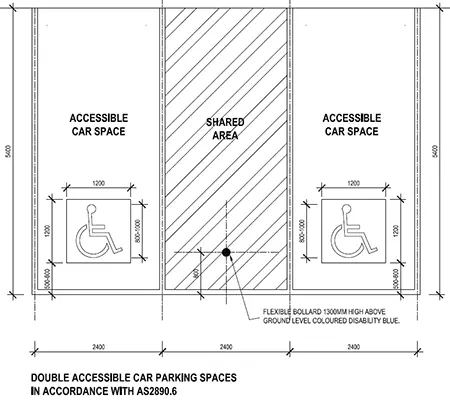
A Disabled Bay Bollard is installed at the head of the "shared zone to prevent unauthorized vehicles from blocking the wheelchair ramp or side-access space. Acts as a physical barrier to safeguard space for passengers with mobility devices or those needing side-loading vehicles
-
1300 mm High
-
Positioned centrally at the head of the shared zone.
-
Safety Yellow
-
Reflective band red/white
The previous carpark design of 3.2M x 5.4M whilst providing enough space for wheelchair users to side transfer into motor vehicle did not allow sufficient space for ramped side access, see photo below. With the introduction of Australian Standard AS2890.6 the shared common space has been adopted to make vehicle access easier and safer. Easier because it provides sufficient space for side access vehicles which provide a safer way of accessing motor vehicles instead of rear access into traffic access lanes etc.
Cad Plans
Download the CAD File for carpark designs.
Space Identification
Each dedicated space shall be identified by means of a white symbol of access in accordance with AS 1428.1 between 800 mm and 1000 mm high placed on a blue rectangle with no side more than 1200 mm, placed as a pavement marking in the centre of the space between 500 mm and 600 mm from its entry point as illustrated.

Compliance Isn’t Optional
Compliance with as2890.6 is not a discretionary guideline; it is a legal and regulatory necessity. The National Construction Code (NCC) references this standard as a ‘Deemed-to-Satisfy’ solution for providing accessible car parking spaces. Failure to adhere to these specifications will result in Development Application (DA) rejections or costly Requests for Information (RFIs) from council, leading to significant project delays.
Parking Space Dimensions
The standard car parking space for people with disabilities must be designed to accommodate a range of vehicles and user needs. The critical minimum dimensions are:
-
Width: A minimum of 2.4 metres
-
Length: A minimum of 5.4 metres
For parallel parking spaces, the required length increases significantly to 8.8 metres to allow for safe entry and exit. While angle parking (e.g., 90, 60, or 45 degrees) uses the standard 2.4m x 5.4m space, it requires an adjacent shared zone, which is a critical component of the overall design stipulated by as2890.6.
ADVANCED POLYMER INGROUND IMPACT RECOVERY BOLLARD

ADVANCED POLYMER SURFACE MOUNT IMPACT RECOVERY BOLLARDS


STEEL INGROUND IMPACT RECOVERY BOLLARDS
STEEL SURFACE MOUNT IMPACT RECOVERY BOLLARDS


Advanced Polymer Bollards
Highly durable Non-Conductive Bollards made from Advanced Polymers are impact, scratch , dent resistant, will not chip or fade like powder coated bollards. Western Power/ Synergy Approved.
In-ground Advanced Polymer bollards Western Power

Carparks
Great for carparks. Highly durable Bollards made from Advanced Polymers are impact, scratch , dent resistant, will not chip or fade like powder coated bollards and are non-conductive. Secured using Impact Recovery System bollards become reusable even following severe impact
Impact Tested to 10 kmph

In-ground
You can install Advanced Polymer Bollards in-ground, or using the Impact Recovery System (making bollards and foundations re-usable even following severe impact)
Suggest Impact Recovery System when bollards may be subject to severe impact.
In-ground Impact Recovery bollards

Surface Mount
You can surface mount Advanced Polymer Bollards using the Impact Recovery System (making bollards and foundations re-usable even following severe impact)
Perfect for carparks and locations where bollards will receive light impact
Surface Mount Impact Recovery bollards

Safer than steel
Unlike steel bollards, Advanced Polymer Bollards are far more durable and won't damage vehicles if impacted. They don't fade, dent or scratch like steel bollards and with no springs, bollards won't become "floppy" over time and cause litigation risks.
Surface Mount Impact Recovery bollards

Stop damage to footings!
Unlike steel bollards, Advanced Polymer Bollards are far more forgiving- able to absorb light impact and self recover. When secured using the Impact Recovery System
Bollards and footings become reusable following even severe impact - saving thousands
Photo of in-ground steel bollards

Stop damage to vehicles!
Unlike steel bollards, Advanced Polymer Bollards are far more forgiving with a soft surface - protecting vehicles against damage when impacted. If secured using the Impact Recovery System Bollards they provide even greater protection against damage
Photo of dented vehicle

Dent resistant
Most plastic bollards / bollard covers are 1-3 mm thick, so dent and crack if impacted. ZERO bollards & covers are 7 mm thick (made from a material that will self-recover from impact) making them highly resistant to impact and denting - greatly improving resilience and lifespan
Photo : Zero Bollards shown on right
UV resistant
Made from Adavnced Polymers that have built in UV Stabilisers these bollards exceed Australian Standards lasting 50 years in shade and 25 years in direct sunlight wihtoiut fading, cracking or splitting.
Photo : Zero Bollards